Showing posts with label rant. Show all posts

Things I've noticed about Japanese anime pt. 2

Another thing about Japanese anime is that in most cases it does not illustrate what living in Japan is really like, both for Japanese natives and foreigners as well. Although I've never lived in Japan, I am sure of this, having watched or read people's testimonies on youtube and various blogs. Sometimes anime completely misconstrues what happens in real life, and other times it presents the topic from the wrong angle.

For example, school girls do not wear mini skirts, and cultural festivals do not turn every schools into maid cafe theme parks. And curry isn't the only thing Japanese like to eat for dinner. The list can go on as to show how Japan is significantly more perverted in anime than in real life.

I think this sense of other-worldliness can be explained by two things. First, anime bears a negative connotation in Japan that, while it appears in the mainstream for kids, puts adult fans in a bad light. Because of this, anime schools are attended by people who are generally poor financially and academically and are in the margins of the society, and so the animators are obviously going to have a perception of the world that is drastically different from the normal experience. The other reason is that anime serves as an escape from the real world for its audience, although people of different cultures have different things to escape from. I think for some Asians there can be this desire to separate oneself from certain practices or situations in a uniquely Asian context that are humiliating or unsettling. Students (including those in Korea) may want to completely do away with gym/disciplinary teachers who mete out embarrassing corporal punishments. Or guys might get sick of old ladies (including their moms) who are obsessed with store prices and haggling. And some Asians may wish their language sounded more sophisticated in western style and less "piko-piko" or "chingchongching"-ish.  And it is in the backdrop of this self-hating repulsion (but it's not anything serious) that emerges a paradisiacal image of a western medieval castle with a princess and a knight in shining armor, which then is the alternate reality of the anime.

I've also found that it's hard to find kids in anime who actually have parents or interact with them. A surprisingly large number of animes feature main characters as orphans or living separated from their parents (including Full Metal Panic, Elfen Lied, Neon Genesis Evangelion, True Tears, School Rumble, and Suzumiya Haruhi). And in the animes that depict parents, even for a brief moment, they are merely annoyances or play subservient and non-intrusive roles for the main characters. This could be because a lot of people in the animation industry are likely to have been students with poor grades when they were teenagers, and that generally correlates with more problems and difficult relationships with parents. Also, the teenagers, who are a main audience group, probably won't like having to deal with mom and dad even on the tv screen.

We've seen how animators like to deviate from the real world in their works, but some have surprised me with their depiction of scenery or personalities with such character and realism. Believe it or not, some of the characters in anime can actually be found in real life with the same impressionistic facial traits, dress style, and language. For example, the aunt in Summer Wars is so like the mean aunt you meet in a gathering among relatives of a large extended family, and you want to hate and ridicule her face, but you really can't because she doesn't look bad at all.

The aunt is on the right with red hair
In A Place Promised In Early Days, Takuya and Hiroki are example of childhood friends who differ sentimentally in their attachment to each other when they become adults. One is naturally going to look coldhearted and insensitive, while the other will seem naive and idealistic.

Also, I was delighted to watch how kids in Denno Coil like to play in the streets in an army command style because I've seen that myself when I was a kid and was living in Korea. It would be hard to imagine how that would happen in America, since kids are confined to playing sports on the grass or at home and are sheltered from the street influences.

For some reason I can't think up more examples, so I will call it for this post.

Things I've noticed about Japanese anime pt. 1

Occasionally I have the urge to do random things, like making a youtube video with ysflight, and, recently, writing a wiki encyclopedia article about anime (and that's why the blog hasn't been updated in 3 months). But since I will never finish it, and no one will actually read it, I've decided to spend more time writing on this blog again.

Ever since I started watching anime since ... 1995? I've noticed certain things that are common in anime or its genres. (My TV at home had a channel (probably Tooniverse) that was dedicated to anime and cartoons 24/7. I vaguely remember when I was about 4 years old, and I could not finish watching one of the last episodes of Nadia with the flying N-Nautilus submarine because my mom had to take me to a dinner. At the time I presumed all anime's were Korean because the anime title, character names, opening and ending songs, and voice acting were all changed to Korean or the Korean equivalent of a western name or word.)

Anyways I want to talk about some common features of Japanese anime that other people might have or not have noticed over the years.

First thing is that the main characters and the main antagonists tend to be lighter skinned and more caucasian than the side characters. You can clearly see it in the differences between Shinji Ikari/Shinichirō Nakagami and Toji Suzuhara/Miyokichi Nobuse in Neon Genesis Evangelion and True Tears, respectively. Always in a Gundam series, the maintenance staff are dark-skinned, blackish/bluish-haired rough men and the most deadly enemy pilot is a blonde dude. "Konnichiwa, I am Rei Ayanami, and I'm really light skinned and look caucasian BUT I'm not liked very much (despite Japanese obsession with caucasian looks) AND my fictional self even has real-life fans who adore me precisely because I am lonely and pitiful BUT also pretty ALTHOUGH if you were pretty, you would be popular and not be lonely, and if you were lonely, you would more or less be ugly and not very attractive, so the two cannot actually go together..." Some Japanese animes try to justify the caucasian looks by presenting the characters with mixed heritage, as Chidori Kaname in Full Metal Panic!, Sumeragi Lee Noriega in Gundam 00, and Eri Sawachika in School Rumble. (But Japanese + European = nowhere close to the angelic characters in anime; they usually have pigglish Caucasian looks)
Second, I've noticecd there are characters who make repeated appearances in different animes either as clones or hybrids of favorite personalities. I already indicated above that Shinji and Shinichiro, and Toji and Miyokichi from NGE & TT are parallel characters. Also, Hiromi and Noe in TT seem to be hybrids of Rei and Asuka - Hiromi resembles Asuka physically, but her personality is closer to Rei's, and the opposite is true for Noe. Certain character looks have recurred so frequently that they are pretty much stereotypes. For example, a strong-willed Japanese woman (often older than the main protagonists) with long dark purple or blue hair and big breasts would be the anime stereotype of a modern, beautiful Japanese woman, like Itoko (School Rumble), Katsuragi (Neon Genesis Evangelion), Yurika (Nadesico), and Tamako (Denno Coil). A lot of male protagonists in animes from 1980s and 1990s used to be teenage punks with long zigzagged brown hair and little boys with black or dark blue hair. This was probably so as to avoid alienating the young Japanese male audience and to make the anime seem more racially neutral or balanced.


I think ever since Rei debuted in NGE, the silent female character has also become a permanent icon in Japanese anime. As Ive pointed out previously, this kind of persona is contradictory because girls can't be hot and unpopular at the same time. Examples of Rei clones include Primula from Shuffle! and Ruri from Nadesico. I literally worshiped Rei when I first saw NGE, but eventually I grew out of it. I hated Primula and also the entire series for being so fake (partly because of the contradiction), but I think Ruri-chan from Nadesico plays the role awesomely. Ruri's success as a silent female character has a lot to do with the fact that her persona doesn't ask for cinderalla pity, and her aloofness is self-imposed, primarily because she is a child prodigy who thinks better of herself than of the others, and she doesn't want her space and composure to be degraded by things she calls 'baka.'

(Primula on the left; Ruri on the right)

Old news about Kim Yuna


Gusts Of Popular Feeling: A comic take on Kim Yu-na

For those who haven't read that blog post, I think it's worth while for me to talk about.

Compare the manhwa illustration of Kim Yuna to her real-life photo:


The manhwa version doesn't come close to looking the real Kim! How can the artist justify Kim's green eyes, brown hair, and a Caucasian nose? Indeed such features would better suit the tastes of the average manga/manhwa fans, although a comic like this would be read mostly by kids who will only become confused by this inaccurate depiction of her race. The drawing just looks really annoying to me.

1st manhwa artist


(source: Janimes)
Yi Do-yeong (이도영) (1884-1933) "[expressed]... his ideas in... form of manhwa through ... [a] popular daily newspaper [(Dehanminbo, 대한민보)]... [in] 1909." He was mostly known for opposing Japan's colonization of Korea through his works.
I know there are some very bizarre myths out there about pretty much anything (i.e. Kiss My Kimchi!: Coreans are Caucasians???). Well, ppl, if u were assuming manhwa came from Japanese manga, now u know it didnt!

Watch more Tagstory videos on AOL Video

the star online: "Cute but dangerous?"


Malaysia's the star online reports about the cancellation of an anime adaptation of a Japanese manga, Hetalia.

"As soon as the adaptation of the manga into an animation was announced, a number of South Korean Internet users strongly called for the cancellation of the broadcast, as they felt the South Korean character insults their country. South Korea is depicted as a man who 'is weak before the United States, calls China his elder brother, and hates Japan'."
I actually wouldn't mind S. Korea being portrayed negatively as long as it's accurate. When did S. Korea ever call China an elder brother? Shouldn't that be North Korea? Also, I think "hates Japan" is other way around. Koreans may dislike Japan as a country for trying to conceal its holocaust past, but they don't have to waste their time "hating Japan." If the argument goes, "hey Japan, you used to be criminal," and the reply is "no" or "yes, but let's forget about it," still those war crimes and oppressive acts committed by the Japanese government during colonial rule are Japanese' problem, not Koreans'.

---------------
PS

I found a good discussion at a blog called Anime Might:

"Please excuse me a little bit for leaving you a comment like this.
(Also, my English is not perfect, but I will try my best.)

Actually…I was keeping on watching its progress so far.
How the anime was cancled, and how the Hetalia fans are reacting…kind of thing.

In order to understand the actions taken by (around ten thousands of) Koreans,
people should understand what their real complains are.
They simply have two major points.
1. No more WWII glorification
2. No more distorted Korean character
and there are a lot of ‘detailed’ complains related to it.

For example, many Koreans were offended when Korea in Hetalia was obsessed with Japanese flags.
http://en.wikipedia.org/wiki/Sohn_Kee-chung
Maybe this article can help you understand how Koreans would feel if Korean in Hetalia acts like that.

Koreans were already offended by several “anti-Korean” mangas like this.
http://en.wikipedia.org/wiki/Manga_Kenkanryu
No Koreans signed up to protest about it at this point.
(I saw several Koreans saying “the art style looks too much like Yu yu Hakushou!”, though.)

In addition,
the glorification of WWII in Anime, game, and manga is never, not the first time Koreans are experiencing.
I can think of many examples…
I saw a Korean character in SRWOG (a Japanese GBA game) saying “Tora tora tora”
before the final battle operation. That quote was from Japanese soldiers in WWII.
Most Koreans were used to ignore these kind of things and just enjoy.

Plus, several people were worrying about its “shounen-ai” expression
broadcasted by “kids” station in Japan.

Actually, Korean people did not (could not) stop Hetalia Anime broadcast.
Koreans have no such rights. They can only persuade and protest about the anime.
The Japanese TV station decides it. They said that they had “various circumstances”.
The real reason might be more complicated than people are thinking.

The Japanese TV station did not broadcast the show and Koreans got cooled down a lot for now.
So far, Koreans are OK with Hetalia’s DVD and mobile phone premise, I think.

-
“The show is still available online for those who still want to watch it but the Koreans are also trying to stop that”
->I think you are talking about Youtube broadcast or something.
Online broadcast is illegal. Completely illegal.
In order to watch this anime, you should buy the DVD.
(Japanese people can afford it through mobile phone service, too.)
I think the Japanese anime company is stopping the online broadcast.
They would not be able to make money if everyone watches the anime online.

“How the hell this show insults Korea if they don’t even appear on it. ”
->On the official Hetalia anime website, there definitely was Korea on the list.
You could see the official character design and profile of Korea.
Maybe the animation did not have Korea “yet” at the beginning of the season.
They were going to have Korea at some point.
(Koreans stopped it, so it is hardly going to happen in the furture.)

“…several young Korean’s sliced their finger in protest…”
-> Please, believe me, not much Koreans go THAT far.
That issue (led by some Korean nationalists) and this Hetalia issue (led by Koreans
who are interested in anime a lot….I would say….Korean Otaku?) are completely different.
They have different reasons, different point of view, different reaction, etc.

-

Still, in my opinion, I also think that the way Koreans approached the anti-Hetalia movement was not the best.
They could take time and think of more…smarter and cooler ways.

I just hope that there will be a peaceful resolution…."

Gusts Of Popular Feeling: Kenkanryu in the Realm of the Revisionists

Although I've been reviewing Goong all this time, I finally hit something completely different: Kenkanryu, the "Hating Korea Wave" (or as the article linked below argues, "the 'Hate Korea' Wave").

"Kenkanryu in the Realm of the Revisionists"

I appreciate Matt for his sincere investigation of this very controversial topic. This Matt is much more reliable and genuine than the Matt of Occidentalism, who sounds pretty much like a typical western Japanophile having set out to defend pretty much anything negative about Japan.

These are his posts regarding Kenkanryu. Compare them with the Occidentalism posts: "Kenkanryu in the New York Times" and "A final word on Kenkanryu."

I liked them at first. They are rather more about the New York Times' article, "Ugly Images of Asian Rivals Become Best Sellers in Japan", by Norimitsu Onishi, than the comic itself. Ok. This was the first thing that made Occi Matt sound a little fishy:

"So who is the writer of the article? Judging from his name, ‘Norimitsu Onishi’,
it would seem that he is Japanese, but I have my doubts about that. I would be
willing to bet that he is actually an ethnic Korean.

Norimitsu Onishi just doesnt hate Japan, he seems to hate the US too. In an article for the New York Times, he described terrorists killed by US soldiers as ‘victims‘, putting them in the same category as innocent restaurant workers killed by terrorists."


Strangely enough, one of the characters in the novel is Norimitsu Onishi (the scanlation could be wrong). Anyhow, occi Matt writes in his 2nd post:

"including the author of the NYT article, hack writer Norimitsu Onishi"

Why can't a Japanese be not be anti-Korean? Or rather, why does someone got to be a Korean if he's an anti-Japanese? Then I guess Hideki Kajimura, who made a very neutral presentation of the Dokdo/Takeshima dispute in his article "The Question of Takeshima/Tokdo," isn't a Japanese? And then he tries to get away with all this mischaracterization by saying it doesn't matter if he's a Korean or not. How pathetic.
  • "'It’s not an exaggeration to say that Japan built the South Korea of
    today!' In another passage the book states that 'there is nothing at all in
    Korean culture to be proud of.'"

"In fact, it is clear from reading the comic that the character means that
Japan had laid the foundation of modern development in Korea, by bringing
modernization, economic growth, and social reform."

Simply it's this. These quotes all sound just really dumb, prejudiced, and uninformed, but as you can see Occi Matt tries to defend them as some sort rational historical arguments.

"Actually, not every character Japanese character is drawn with western features,
so this is a huge exaggeration on the part of the author of the article. He can
only get away with it because he knows that the majority will never actually see
the comic."

Actually, Occi Matt can get away with making this claim (not) because the majority will never actually see the comic (not).

"In the picture below, it may be possible to discern which characters are meant
to be perceived as Japanese and which are meant to be perceived as Korean:"
-Matt (Gusts of Popular Feeling)


"Interesting. Let's make a comparison here. Let's say that it was said that in the comic, apples were all drawn to look fresh, but the oranges were drawn to look rotten. The rebuttal to this? "Not all of the apples look fresh. See? I leave it to your judgement." How can anyone judge when no one is shown any oranges?" -Matt (Gusts of Popular Feeling)
Well, I also want to add that I just really love how all the links (or most of them) that Matt put out for us are "Not Found"; this article's a goner and the Nissan Institute of Japanese Studies at the University of Oxford got rid of Cleansing History, Cleansing Japan: Kobayashi Yoshinori’s Analects of War and Japan’s Revisionist Revival. I'm okay with a blog post or an MSN space disappearing, but definitely not a scholarly journal article from public view. So, here's the exact article that I accessed as HTML by Google in doc format.

anxiety amongst Korean anime fans

(Dooly vs. Pikachu)

I found this pretty interesting journal article titled, "Manhwa, Manga, and Cultural Identity: Comic Readers and Nationalism in Korea" (i tried to upload the original to mediafire as alternative link, but it couldn't be b/c "virus found," so this is copy-pasted doc). It was written by a Japanese, Chie Yamanaka, and it's about the anxiety that Korean manhwa fans have about their consumption of Japanese manga and anime. I got to admit that I feel the same way about my liking of Japanese anime and music & that's why I think I quit my previous blog, Flavcorn, and started dokebiclub that focuses solely on Korean manhwa & animation. As I've written in a previous post titled, "Korean Animation," there aren't that many Korean animated works out there, so Korean manhwa fans can't help but watch Japanese anime.

The author points out an inherent contradiction with S. Korea's general rejection of Japanese pop culture (cultural ban on Japanese imports was lifted in 2003) - Korean pop culture is a hybrid culture that already includes Japanese cultural elements. Pepero, for example, is a copy of Japanese Pocky. Even the educational (i.e. elementary 1-6 grades, middle 1-3 grades, high 1-3 grades; instead of grades 1-12 as in the US) & legal systems are a continuation of the procedures established during the Japanese colonial rule.


Is it a problem? Yes it is! I'm like, "it's not too hard to invent your own snacks... why copy?" It's a problem because it allows hot-headed japanophile retards like James on Japan Probe repeat the Japanese racial superiority argument here. I tried to find out if Japan copied anything from Korea & I've yet to find at least 1. If I were to go back 5,000 years, I could find plenty that went from Korea to Japan, like introduction of agriculture, castle-building, metal type printing, porcelains, Buddhism, etc. So, maybe Japanese should forgive Korea for being a copycat just once in a while.


Back to the point... In the end, I think that Koreans should be able to enjoy Japanese culture. It's about time for Koreans to forgive Japan as a country for all the terrible things that happened from 1910 to 1945 & move on (but, that still doesn't mean that Japan can continue to distort history & deny things like comfort women.)

Korean animation

Although manhwa today is a genre that contains numerous comic book titles competing directly with Japanese manga, Korean animation is almost unheard of in the West. Korean animation is several decades old (watch these videos), but still it is "relatively young." In its early years, most Korean cartoons were pirated off of Japanese animation's, so they couldn't be exported (although this practice did help sustain the industry). Eventually, around the 1990s, S. Korean animators got to export overseas, but their works were all subcontracts with foreign companies; for example, PowerPuff Girls, Simpsons, etc. were all drawn in S. Korea, but they are still known as American cartoons. During the same period, the S. Korean animation industry produced several commendable titles, such as Dooly, Hamos, Honggildong, Lazenca, and Restol, but most of them were not exported b/c no one wanted them. Rare appearances of Korean cartoons such as Cubix (which was based in a completely cosmopolitan setting without a single trace of anything Korean in it) on western tv channels were not enough to elicit interests about the Korean animation itself as a genre.

After year 2000, Korean animation did shine a bit with high-quality works such as Wonderful Days, but the situation essentially has remained the same as before. The number of animation series produced in S. Korea annually is still very small, and exports remain minimal. Partly the reason for this situation is that S. Korea is a very small country. Japan, for example, is 3 times as big as S. Korea in terms of population and landmass; therefore, it makes sense that S. Korean animation should be smaller in volume than the Japanese anime. But S. Korean animation isn't 1/3rd the size of Japanese anime; it's more like 1/1000th. I think it's because there is this feedback effect between the market size and production (i.e. $10 million Wonderful Days only made $2 million at the S. Korean box office) due to the fact that, at a similar production cost, Korean animation industry can sow only as much as a 1/3rd of the profit that the Japanese anime industry would make. There is a similar relationship between distribution and the size of a pre-existing fanbase. It's much more difficult for a Korean animation series to be licensed and released in the United States because there is no one who will buy it & sponsor it. It's hard for people outside of S. Korea to even get updated or informed about Korean animation because no one writes about them. Why? Because no one's interested. Why? Because no one writes about them. See the feedback effect?


(Yobi, The Five-Tailed Fox)

If you're interested, here are some Korean animation works from the recent years. The titles are linked to reviews.

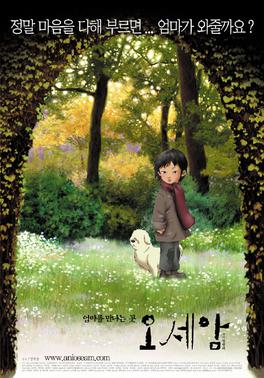
(Oseam poster)

3 articles about Korean animation:

Alternative to current anime/manhwa character style

Someone did agree with my complaints (1 & 2) about anime's inaccurate presentation of Asian features. See my post @ flavcorn on "Japanese anime characters who look Japanese," & read the comments. The tacit assumption among the anime fans seems to be that Asians are just ugly, or they don't look all the interesting, and therefore they would look terribly in a realistic animation.

People who think Asians are ugly just don't know enough about Asia, its traditions, & its pop culture. As I've shown here, Europeans are beautiful & ugly in their own way; it's not simply "oh you have blonde hair & blue eyes, so you are automatically pretty." Anyone could argue with me about this, but why bother? The only thing that matters is that accurate representation of Asian features can be superior to the current anime style (which.... evolved that way gradually for various, legitimate reasons that I've outlined here).

Only reason why Asians don't appear too often in anime's & manhwa's is that the 2D outlines don't suit Asians' gradual facial contours. But I'm sure that, in time, animators will be able to draw with multiple, overlapping transparency layers that will allow Asian facial features to be portrayed accurately.


(click to enlarge)
Copyright @ dokebi club | Floral Day theme designed by SimplyWP | Bloggerized by GirlyBlogger